
MCP Audit is the static analysis engine for MCP Contracts. It runs automatically on every uploaded contract — no live connection, no flag to set — and produces a score, a grade, and a list of findings.
Every finding is classified by who it can hurt — the AI agent consuming your server, or the server's own security posture.
Three engines analyze the free-text description of every tool and prompt in your contract, automatically, on every audit:
| PromptDefense | Checks for absence of defensive language across 12 attack-vector categories. |
| YARA | Matches known malicious signatures — prompt injection, credential harvesting, tool poisoning. |
| LLM opt-in | Semantic reasoning for novel threats signatures can't catch — requires an API key. |
Every content finding carries a remediation string with actionable guidance, shown directly in the Audit tab.
Eight contract sections have a designed rule set, not yet implemented. Today's score for these sections counts placeholder markers only — not real structural or security analysis.
server | Naming, versioning conventions |
integrity | Message signing, rug-pull protection |
authentication | Scheme completeness, fail-closed defaults |
authorization | Role coverage, wildcard-allow rejection |
capabilities | Per-tool security block, risk level, confirmation requirements |
throttling | Rate limiting, fail-closed on limit exceeded |
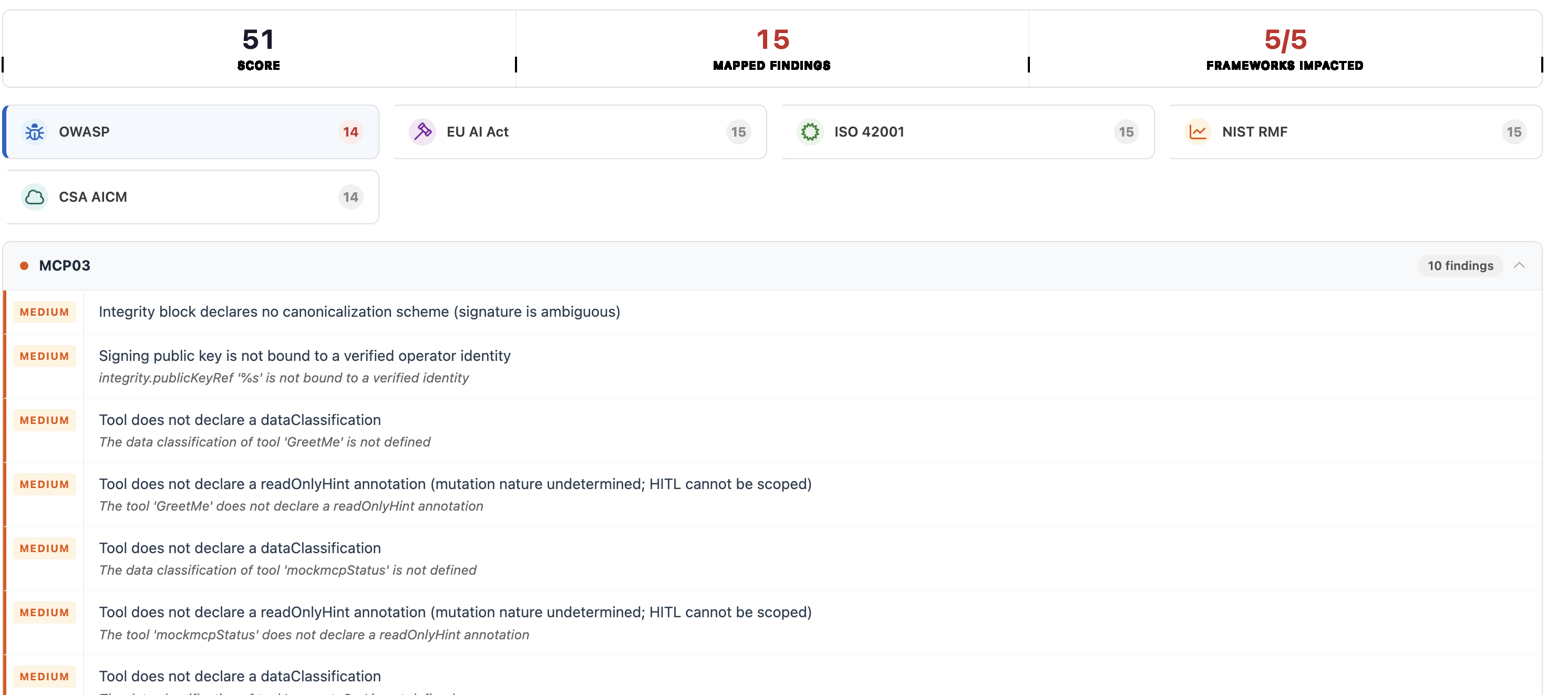
Findings are tagged against OWASP, the EU AI Act, ISO 42001, NIST AI RMF, and CSA AICM automatically — so a security review doubles as compliance evidence without extra work.
See MCP Scan for what runs against the live server, and MCP Protect for runtime enforcement.