42Crunch helps enterprises bring AI security under control. Discover every MCP server your AI agents expose or connect to, secure it against attack, and continuously prove compliance with AI regulations and security frameworks — from day one.
Trusted by security & engineering teams at




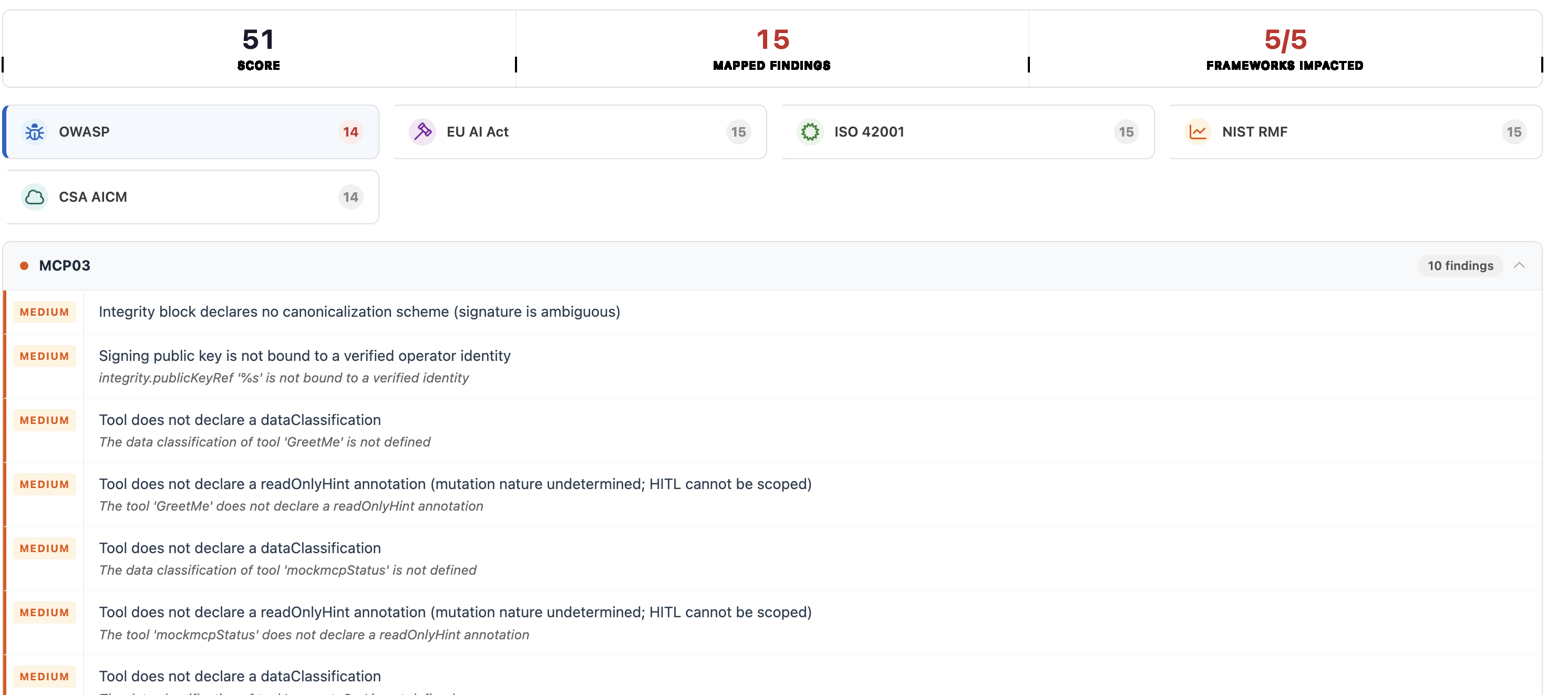
The EU AI Act, ISO 42001, NIST AI RMF, CSA AICM, and OWASP are all tagged automatically, on every audit. A security review doubles as compliance evidence without extra work.
AI coding agents ship MCP servers faster than any manual inventory process can track. 42Crunch discovers every MCP server across your organization automatically, both sanctioned and shadow alike, audits each one, and ranks it by risk.
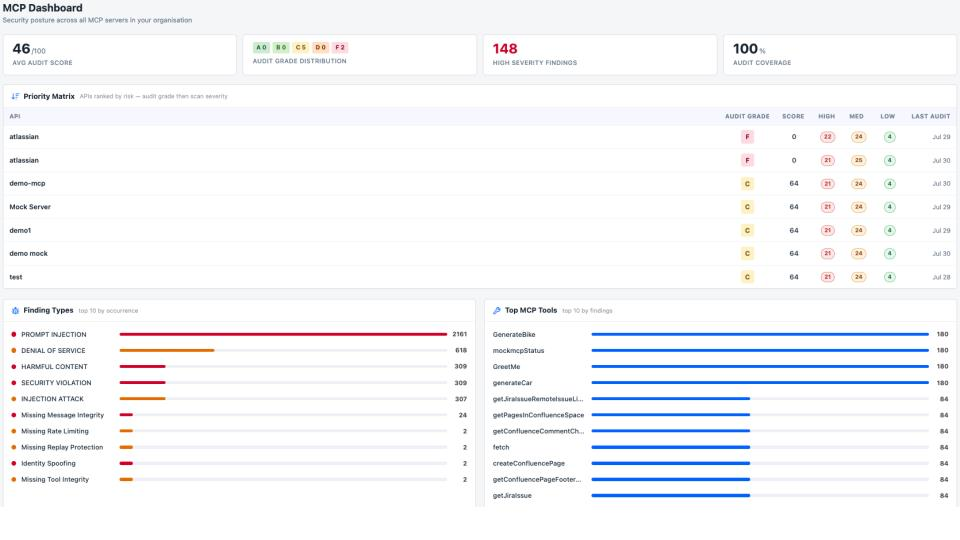
Every request from an AI agent passes through the MCP server before it ever reaches an enterprise system or the API behind it. That's the one place AI server-side security governance has to sit and be evaluated continuously, not sampled once. An MCP tool is only as secure as the API it wraps. The 42Crunch platform's deterministic contract-driven model applies equally to the MCP and API layer, ensuring a well-governed MCP server is never sitting on top of ungoverned APIs.
Every MCP server and every API behind it gets a machine-readable contract of its declared surface. Discovery writes it, testing measures against it, runtime enforces it.
Auto-discover and inventory every server; generate its contract automatically.
Sweeps registries, gateways and repos to surface the shadow servers agents are already calling, then reads each server's advertised tools, resources and prompts and emits a contract — the declared surface everything downstream is measured against.
Score every server against its contract and the OWASP MCP Top 10.
Grades each server on its own declared surface and on the OWASP MCP Top 10 — tool poisoning, injection through tool descriptions, over-broad scopes, unauthenticated transports. Every finding carries severity, evidence and the fix.
Gate non-compliant servers in CI/CD; catch drift in running servers continuously.
Fails the build when a server leaves its approved contract, then keeps watching the one in production: new tools, rewritten descriptions and widened permissions are caught as they appear rather than at the next audit.
Map every finding to NIST, EU AI Act, ISO 42001 and CSA AICM controls.
Each finding arrives already tied to the control it answers, so the audit trail for your AI estate is a by-product of the scan instead of a separate programme of work.
Static and dynamic testing against the contract, mapped to the OWASP API Top 10. Auto-remediation of AI generated code in IDE and agentic workflow.
Tests are generated straight from the OpenAPI definition and run in the pipeline — broken object-level authorization, broken auth, mass assignment, unrestricted resource consumption — with each result mapped to the OWASP API Security Top 10. All AI generated code is automatically fixed by 42Crunch.
Contract-driven allowlist blocks anything undeclared — sub-millisecond overhead.
A positive-security firewall assembled from the contract itself: unknown paths, extra parameters, malformed payloads and over-sharing responses are rejected before they reach the backend, at sub-millisecond latency.
The same contract model, one layer down — applied to the API surface the tool actually touches.
Hover — or tap — a capability to see which layer it governs.
42Crunch's unique contract-driven security platform already secures APIs for leading global enterprises. This same proven model now extends to the MCP servers AI agents call and expose. If you're already securing your APIs with 42Crunch, you've got a head start on AI security.
A decade of API governance, now extending to AI agents.

"Fantastic product, great peace of mind, amazing support staff."
Engineering Manager, enterprise customer
42Crunch named overall leader in API management & security.
KuppingerCole Leadership Compass
Recognized across Omdia, TAG Cyber, and Gartner coverage of API security.
Analyst coverage of the API security platform
Linters and DAST tools check structure or HTTP traffic, but none of them read a tool description for prompt injection. Runtime API security tools observe traffic after deployment, but none of them provide a security-by-design approach within the IDE and CI/CD pipeline. MCP-specific security tooling doesn't exist as a category yet.
| Capability | 42Crunch | Traditional DAST | WAF | API Gateway |
|---|---|---|---|---|
| Tool description / prompt injection analysis | Yes | No | No | No |
| Protocol-level MCP controls (8 checks) | Yes | TLS only | TLS only | Partial |
| Rug-pull / tool integrity checking | Yes | No | No | No |
| Runs offline / air-gapped | Yes | No | N/A | N/A |
| OWASP MCP Top 10 coverage | 10 / 10 | 1–2 | 1–2 | 2–3 |




How 42Crunch discovers, audits, scans, and protects MCP servers. See it mapped to the OWASP MCP Top 10 and AI Acts and frameworks.
Read datasheet →APIs are now the primary interface AI systems use to touch business data. What to look for in testing tools built for that reality.
Read guide →Vulnerability and implementation-mistake data from across the platform's install base.
Read report →Discovery works outside-in against the infrastructure and network surface your organization already controls, rather than relying on teams to self-report — so a server stood up without a ticket or a security review still shows up in the inventory.
Yes — discovery and audit run as one motion. A newly found server is scored against the same deterministic baseline as every other server in the estate, which is what makes audit coverage a trackable percentage instead of a best guess.
Discovery is what populates the MCP Dashboard in the first place — the average audit score, grade distribution, and Priority Matrix you see there are built from every server discovery has found and audited.
NIST AI RMF (United States), the EU AI Act (European Union), ISO/IEC 42001 (international management-system standard), the OWASP MCP Top 10 (global security baseline), and the CSA AI Controls Matrix (global, cloud-focused). Each is evidenced continuously, not assembled from documents at audit time.
Yes — every audit and scan checks a server against all applicable frameworks simultaneously, so a server serving users in the US and the EU gets NIST AI RMF and EU AI Act findings side by side, in the same report.
Deterministically, by the control, on every audit and every scan. The same MCP server evaluated twice returns the same score and the same findings — nothing is estimated by a language model or assembled retroactively from policy documents.
Yes, for content/agent-facing threats — prompt injection, tool poisoning, data exfiltration, and tool shadowing are analyzed automatically with severity and remediation guidance. Structural contract checks (authentication schemes, authorization completeness) are still in design and not yet scored.
No — point the scanner at a live server URL and it discovers tools, resources, and prompts automatically, generating the contract for you.
A single minimum-score threshold per API (default 75, grade B). Per-compliance-framework gating (EU AI Act, NIST, ISO 42001) is on the roadmap, not yet a selectable feature.
API Audit is static — it tests the OpenAPI contract itself, before any implementation exists. API Scan is dynamic — it tests the running API with simulated traffic, checking that the implementation actually behaves the way the contract says it should.
No — it's purpose-built for the API layer specifically, which generic SAST/DAST tools weren't designed to understand. Most teams run both: general AppSec tooling for the wider codebase, and 42Crunch for the OpenAPI-contract-specific detail that generic tools miss.
By testing the contract itself — before implementation begins — rather than waiting for a running service to scan. A vulnerability caught in the OpenAPI definition at design time is dramatically cheaper to fix than the same issue caught in production.