Real-time compliance and security enforcement for the agentic enterprise.
As AI agents take on more autonomous work inside the enterprise, MCP has become the default way they reach tools, data, and systems which are for most organizations, the default blind spots. There's no consistent way to know what's exposed to an agent, whether it's safe, or whether the controls around it would hold up if a regulator or auditor asked.
Most of what an MCP tool actually does, it does by calling an API underneath it. Every MCP server an enterprise exposes to agents is also, quietly, exposing the APIs behind it. Governing the agent-facing surface without governing what it reaches is only half the job.
Every request from an AI agent passes through the MCP server before it ever reaches an enterprise system or the API behind it. That's the one place governance has to sit and be evaluated continuously, not sampled once. An MCP tool is only as secure as the API it wraps. The 42Crunch platform's deterministic contract-driven model applies to the MCP and API layer, ensuring a well-governed MCP server is never sitting on top of ungoverned APIs.
Every MCP server and every API behind it gets a machine-readable contract of its declared surface. Discovery writes it, testing measures against it, runtime enforces it.
Auto-discover and inventory every server; generate its contract automatically.
Sweeps registries, gateways and repos to surface the shadow servers agents are already calling, then reads each server's advertised tools, resources and prompts and emits a contract — the declared surface everything downstream is measured against.
Score every server against its contract and the OWASP MCP Top 10.
Grades each server on its own declared surface and on the OWASP MCP Top 10 — tool poisoning, injection through tool descriptions, over-broad scopes, unauthenticated transports. Every finding carries severity, evidence and the fix.
Gate non-compliant servers in CI/CD; catch drift in running servers continuously.
Fails the build when a server leaves its approved contract, then keeps watching the one in production: new tools, rewritten descriptions and widened permissions are caught as they appear rather than at the next audit.
Map every finding to NIST, EU AI Act, ISO 42001 and CSA AICM controls.
Each finding arrives already tied to the control it answers, so the audit trail for your AI estate is a by-product of the scan instead of a separate programme of work.
Static and dynamic testing against the contract, mapped to the OWASP API Top 10. Auto-remediation of AI generated code in IDE and agentic workflow.
Tests are generated straight from the OpenAPI definition and run in the pipeline — broken object-level authorization, broken auth, mass assignment, unrestricted resource consumption — with each result mapped to the OWASP API Security Top 10. All AI generated code is automatically fixed by 42Crunch.
Contract-driven allowlist blocks anything undeclared — sub-millisecond overhead.
A positive-security firewall assembled from the contract itself: unknown paths, extra parameters, malformed payloads and over-sharing responses are rejected before they reach the backend, at sub-millisecond latency.
The same contract model, one layer down — applied to the API surface the tool actually touches.
Hover — or tap — a capability to see which layer it governs.
A machine-readable contract declares how an MCP server is intended to behave; what tools it exposes; what data they touch and what's permitted. That MCP contract becomes the single source of truth for discovery, scoring, and enforcement alike. Assessment is deterministic throughout: the same server evaluated twice returns the same score, the same findings, and the same verdict, which is what makes the result usable as audit evidence rather than a snapshot from a dashboard.
Learn More →Continuous, zero-touch discovery of MCP servers across the enterprise. As servers are found, the platform generates an initial contract for each automatically with an inventory of every tool, resource, and prompt a server exposes, with best-effort inference of risk level and data sensitivity.
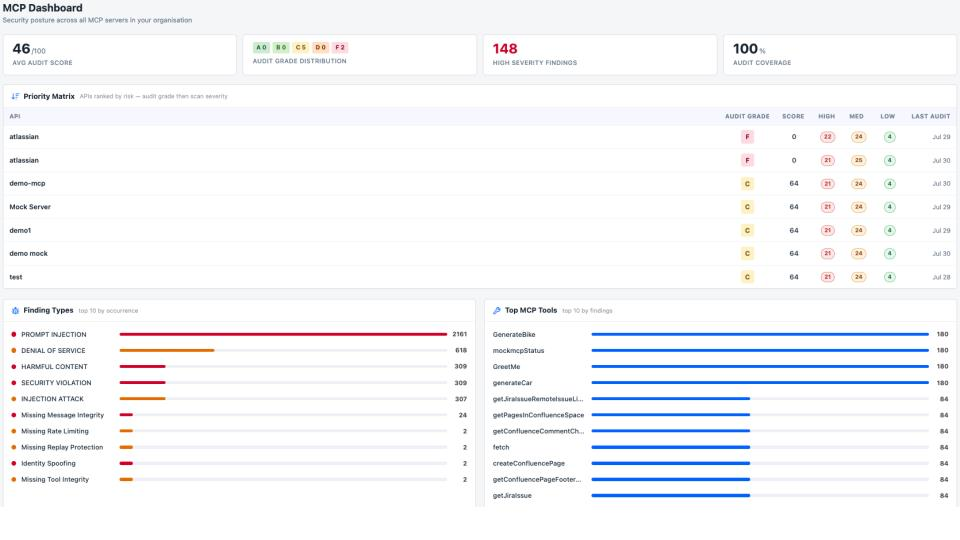
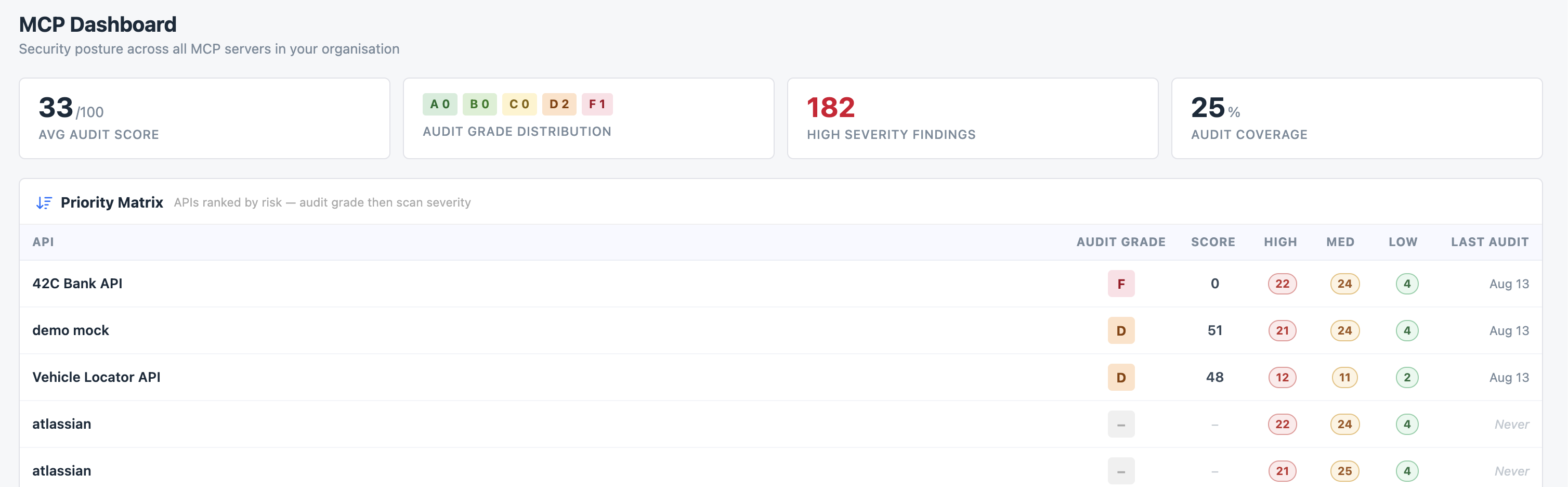
Deterministic assessment is made against the contract, covering both the content an agent will read and the protocol the server speaks. It identifies agent-facing threats like prompt injection and tool poisoning, alongside structural checks mapped to the OWASP MCP Top 10. Every server gets a score, a grade, and remediation guidance per finding.
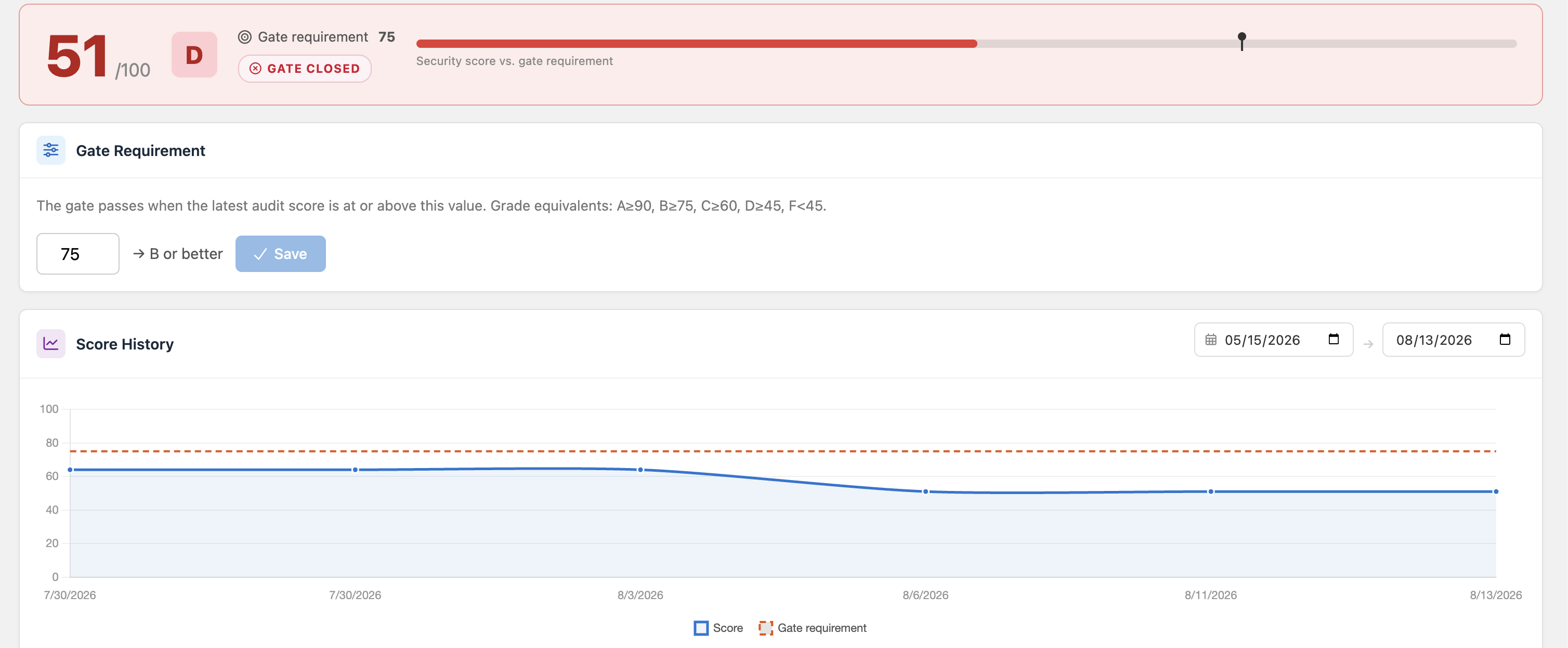
The approved contract is enforced continuously, not just checked once. Security Quality Gates block non-compliant or drifted servers in CI/CD, and running servers are continuously re-tested so an unauthorized change is caught between review cycles, not at the next audit.
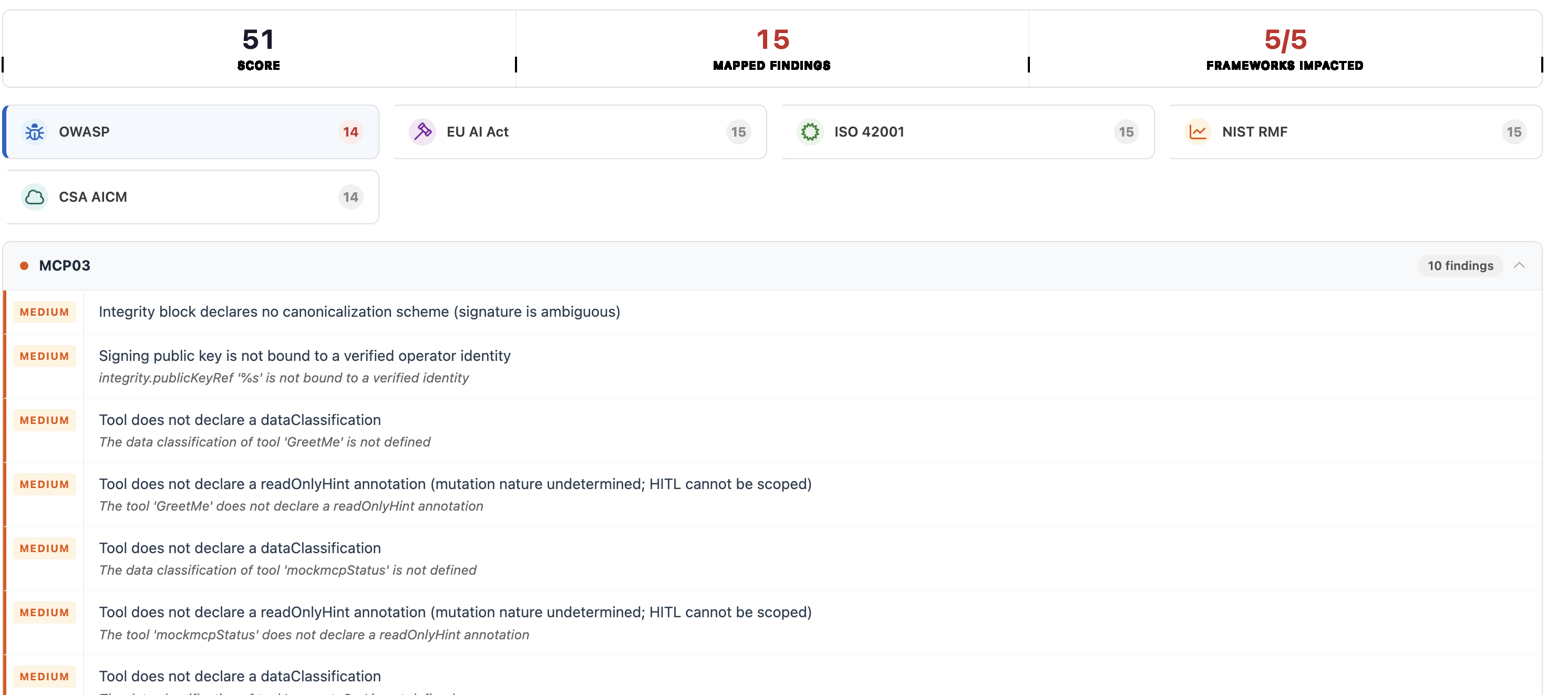
Real-time compliance reporting against NIST AI RMF, the OWASP MCP Top 10, the EU AI Act, ISO/IEC 42001, and the CSA AICM. Every finding maps to the control it breaches, and compliance state exports as a versioned report for auditors and regulators.
| Framework | What the platform evidences |
|---|---|
| NIST AI RMF | Govern, Map, Measure, and Manage functions evidenced for every agent-accessible tool surface. |
| OWASP MCP Top 10 | Deterministic coverage of all ten MCP vulnerability classes. |
| OWASP API Security Top 10 | Coverage across the REST and GraphQL APIs those MCP tools call, via the same underlying engines. |
| EU AI Act | Technical documentation, logging, human oversight, and risk-management obligations for high-risk AI systems. |
| ISO/IEC 42001 | AI management-system controls operationalized as machine-checkable requirements. |
| CSA AICM | AI Controls Matrix domains, including CCC and GRC control families, mapped to concrete findings. |
An MCP tool is only as governable as the API it wraps. The same contract-driven model that governs MCP servers extends down to that layer, so the enterprise isn't left with a well-governed agent interface sitting on top of ungoverned APIs.
Continuous inventory across repositories, developer portals, gateways, and runtime logs, so no API goes unaccounted for, including the ones an MCP server quietly wraps.
Static analysis runs 300+ automated checks against the API's own definition, with real-time scoring in the IDE and CI/CD. Dynamic testing then validates the running service against that contract using simulated real traffic, mapped to the OWASP API Security Top 10.
The approved contract becomes the enforcement policy at runtime. A micro-firewall builds an allowlist directly from the contract and anything that deviates is blocked, with a sub-millisecond overhead. A positive security model, not a simple blocklist.
The same audit, scan, and protect cycle applied to GraphQL schemas as is applied to REST APIs, with full introspection risk, query-cost controls, and federation security.
The producer/consumer standard teams already write to is created via the 42Crunch IDE extension, the 42Crunch platform's own editor, or generated automatically from observed traffic.
Every MCP server, and the APIs it calls, is found automatically, assessed continuously against its contract, and held to that contract in CI/CD and at runtime. One governance cycle, running for as long as the server and its APIs exist, not a one-time review.
Auto-inventory every MCP server and the APIs it calls, enterprise-wide.
Score against the contract and the frameworks the organization is accountable to.
Gate in CI/CD, block drift and non-compliance, continuously.
42Crunch governs every MCP server an organization exposes, and the APIs those tools reach, under one deterministic model.