
AI coding agents ship MCP servers faster than any manual inventory process can track. 42Crunch discovers every MCP server across your organization automatically — sanctioned and shadow alike — audits each one, and ranks it by risk.
Every team with an AI coding agent can stand up an MCP server in minutes — no ticket, no review, no security sign-off. Multiply that across every repo, every side project, every proof of concept, and most organizations end up with an MCP footprint no single team can name in full. You can't set a Security Quality Gate on a server nobody told you about. Discovery is the step before governance, not an optional add-on to it.
Three things a spreadsheet can't do.
Every MCP server is found and cataloged without anyone having to register it — no onboarding form, no tagging convention to enforce, no server left off the list because a team forgot to tell security.
Every discovered server is audited and scored immediately, then ranked by audit grade and finding severity — so the priority matrix tells you which server to look at first, not just what exists.
Audit coverage is a number, not a feeling — track the percentage of your discovered MCP estate that's actually been assessed, and close the gap to 100% deliberately instead of hoping nothing was missed.
The MCP Dashboard rolls every discovered server into one view: average audit score across the estate, audit grade distribution, high-severity finding count, and audit coverage — then a Priority Matrix ranks every server by audit grade and scan severity, so the worst-governed server in your organization is always at the top, not buried in a list sorted by name.
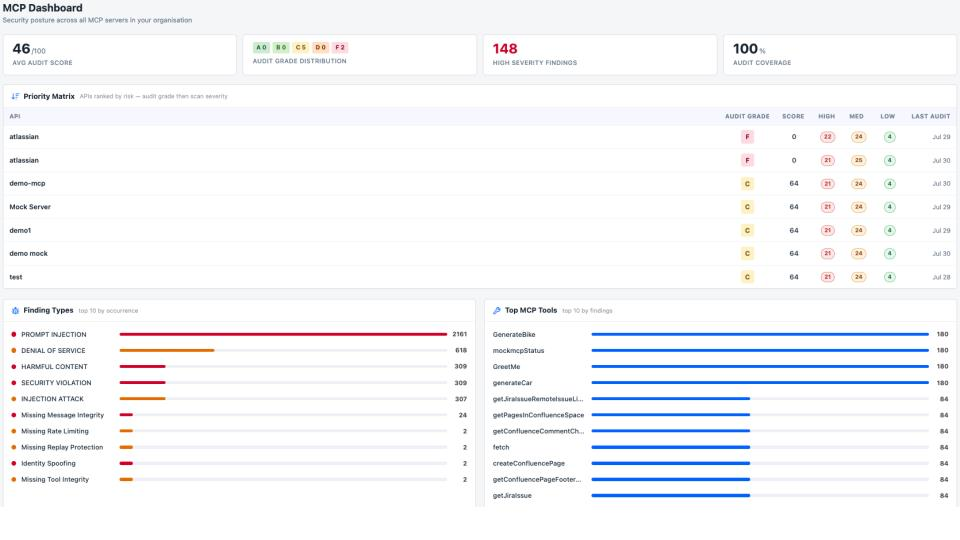
Discovery isn't only about knowing a server exists. Every audit feeds two org-wide views: the finding types occurring most often across every server — prompt injection, denial of service, harmful content, and the rest of the OWASP MCP Top 10 — and the specific MCP tools generating the most findings, so remediation can start with the tool causing the most damage across your estate, not the loudest ticket.
No separate tool, no separate process — discovery just starts the loop.
Every MCP server across the organization is found automatically.
Each discovered server is assessed against the same deterministic baseline.
The Priority Matrix orders every server by audit grade and severity.
Ranked servers move straight into SQG thresholds and CI/CD gates.
Every discovered server's findings are tagged against OWASP, the EU AI Act, ISO 42001, NIST AI RMF, and CSA AICM automatically — so "how many MCP servers do we have, and are they compliant?" has a real answer instead of a shrug. See AI Regulatory Compliance for how that mapping works across geographies.
Discovery works outside-in against the infrastructure and network surface your organization already controls, rather than relying on teams to self-report — so a server stood up without a ticket or a security review still shows up in the inventory.
Yes — discovery and audit run as one motion. A newly found server is scored against the same deterministic baseline as every other server in the estate, which is what makes audit coverage a trackable percentage instead of a best guess.
Discovery and audit happen immediately; governance — setting a Security Quality Gate threshold and wiring it into CI/CD — is a deliberate step your team takes once a server's owner and risk tier are known. See AI Security Posture Assessment for how that threshold gets set and enforced.
A spreadsheet only contains what someone remembered to add. Discovery finds servers regardless of whether anyone told security about them, and every entry comes pre-scored and ranked by risk — not just a name and a URL.
Yes. Servers are tracked per environment, so a proof-of-concept in dev and its production counterpart are both visible and can carry different Security Quality Gate thresholds appropriate to their risk.
Discovery is what populates the MCP Dashboard in the first place — the average audit score, grade distribution, and Priority Matrix you see there are built from every server discovery has found and audited.
Point 42Crunch at your organization and get a complete, risk-ranked inventory back. No agent, no deployment, no commitment required.