
MCP has become the de facto standard for AI agent-to-tool integration. AI agents now autonomously invoke tools, read resources and act on enterprise data through MCP servers, shifting integration from deterministic API calls to dynamic, agent-driven interactions. But MCP adoption is outpacing governance — Gartner reports that 40% of developers cite security, privacy or regulatory concerns with AI-powered applications.
42Crunch enables enterprises to govern the MCP servers they expose to agents, partners and customers. It goes beyond discovering servers and identifying risks: it evidences compliance against the frameworks you are accountable to, remediates vulnerabilities and blocks non-compliant servers — ensuring only secure, approved MCP services reach production.
Auto-discover, register and inventory MCP servers. Generate an MCP Contract for every server.
Score data, security and protocol against the 42Crunch Knowledge Base — a deterministic baseline.
Drift and policy-conformance scanning. Identity, runtime and behavioral tests.
Enforce Security Quality Gates in CI/CD. Block non-compliant servers, close the feedback loop.
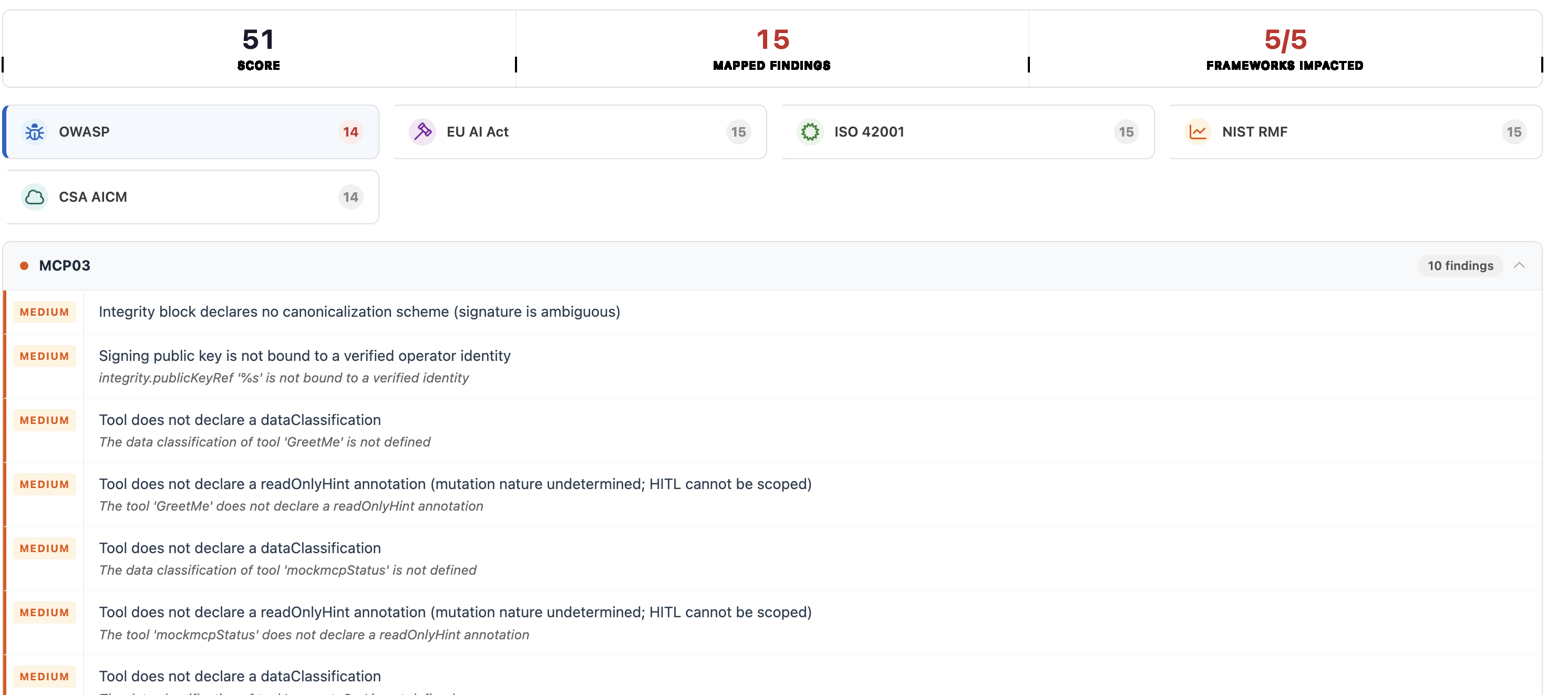
42Crunch continuously evaluates every MCP server against the regulatory and industry frameworks your organization is accountable to, and maps each individual finding to the specific control it breaches. Compliance posture is computed by the control itself on every audit and every scan — not assembled from documents at audit time.
| Framework | What 42Crunch evidences | Reporting |
|---|---|---|
| NIST AI RMF | Govern, Map, Measure and Manage functions evidenced for every agent-accessible tool surface. | Per-finding control mapping |
| OWASP MCP Top 10 | Deterministic coverage of all ten MCP vulnerability classes, scored per server. | Scored 0–100 / A–F |
| EU AI Act | Technical documentation, logging, human oversight and risk-management obligations for high-risk AI systems. | Versioned audit record |
| ISO/IEC 42001 | AI management-system controls operationalized as machine-checkable requirements. | Continuous conformity |
| CSA AICM | AI Controls Matrix domains — including CCC and GRC control families — mapped to concrete findings. | Per-domain findings |
| Continuous evidence | Every audit, scan and Security Quality Gate decision produces a versioned, scored, framework-mapped record — not a point-in-time attestation. |
| Deterministic | The same server evaluated twice returns the same score, the same findings and the same verdict — not LLM-judged. Reproducibility is what makes a record admissible as audit evidence. |
| Finding-level traceability | Each finding carries a control reference, severity and remediation, so remediation effort maps directly to regulatory exposure. |
| Exportable reporting | Compliance state downloads as a report for auditors, regulators and customer security reviews — without manual assembly. |
| Enforced, not advisory | Security Quality Gates block non-compliant MCP servers in CI/CD before they reach production. |
| Cross-framework reuse | Each finding is evaluated once and mapped simultaneously to every framework it touches — NIST AI RMF, OWASP MCP Top 10, EU AI Act, ISO 42001, CSA AICM — so GRC teams stop re-running a separate assessment per regulation. |
42Crunch generates an MCP Contract for each server: a machine-readable, declarative specification of how that server must operate — its authentication requirements, authorization policies, operational limits, what each tool is permitted to do, and which security controls must be enforced. Every contract is written against a common enterprise policy schema, so coverage is consistent across the entire estate while remaining specific to each server. This contract is the single source of truth across discovery, audit, scanning and compliance reporting — every server is evaluated against explicit, approved requirements rather than subjective assessment.
42Crunch continuously discovers MCP servers across the enterprise and generates an initial contract for each. Security teams gain an immediate inventory and risk assessment without waiting for developers to document servers manually.
Each MCP tool is evaluated according to the sensitivity of the data it handles, the actions it performs and its actual response schema. Tools that modify data or perform high-impact actions are assigned a higher risk rating and subjected to stricter controls, including human-in-the-loop approval.
42Crunch continuously tests running MCP servers against their approved contracts, identifying OWASP MCP Top 10 vulnerabilities and unauthorized changes to tools, authentication, permissions, schemas, rate limits or runtime behavior before they expose connected agents and enterprise systems.
Every security assessment and Security Quality Gate decision creates a versioned, scored governance record, providing evidence that required controls were evaluated and enforced.
By validating tool definitions, inputs, credentials, permissions, isolation and delegated identity against the approved MCP Contract, 42Crunch blocks unsafe MCP servers before connection and detects drift or malicious changes after deployment. The matrix below represents the principal ways an MCP server can be manipulated, over-privileged or used to expose enterprise systems and data.
| MCP Vulnerability | Description |
|---|---|
| Tool Poisoning | Malicious instructions embedded in tool descriptions that hijack LLM behavior. |
| Rug Pulls | Dynamic replacement of a trusted tool definition with a malicious one at runtime. |
| Code & Command Injection | Model-provided inputs passed directly to shell, SQL, or system APIs without validation. |
| Credential Leakage | API keys and OAuth tokens improperly stored, logged, or cached. |
| Excessive Permissions | Over-privileged tools violating least-privilege — one breach compromises everything. |
| Insufficient Isolation | Cross-tenant data leakage, shared service accounts, unsandboxed execution. |
| Confused Deputy | Token passthrough allows an MCP server to be tricked into misusing user privileges. |
Source: OWASP, A Practical Guide for Secure MCP Server Development.
NIST AI RMF · OWASP MCP Top 10 · EU AI Act · ISO 42001 · CSA AICM — all enforced through 42Crunch Security Quality Gates.
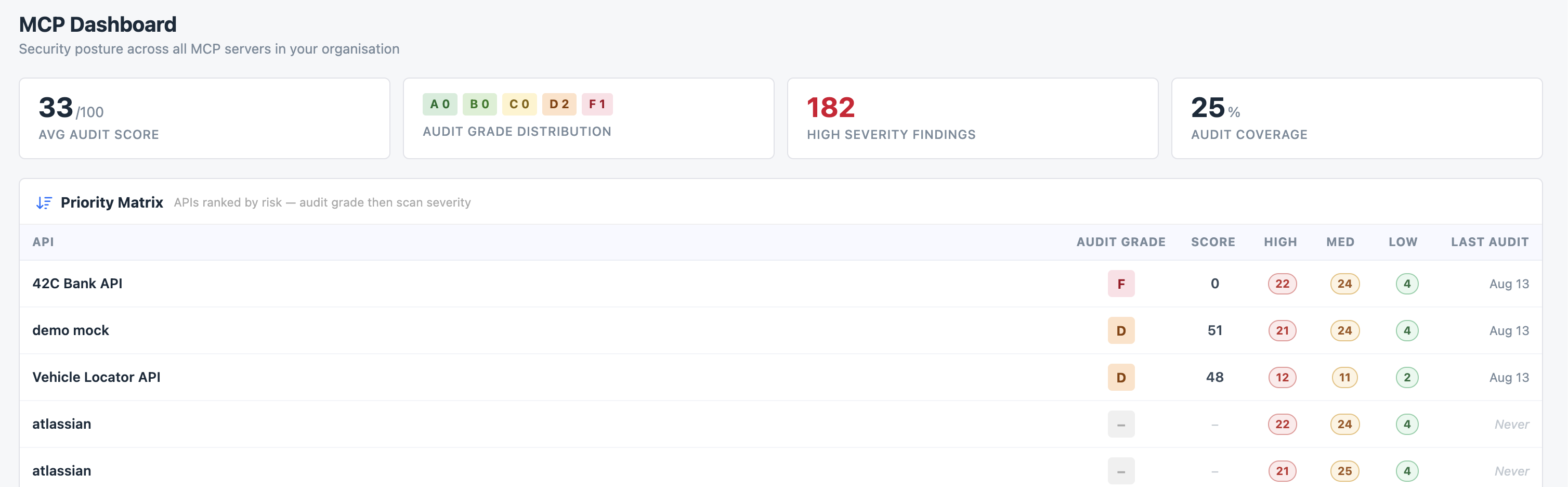
Score any MCP server rapidly, prioritize remediation sooner, and shorten the security review to avoid release delays.
Auto-inventory of MCP servers across cloud infrastructure, with evaluation starting immediately to accelerate time to market.
Deterministic coverage across all OWASP MCP Top 10 vulnerability classes, to reduce gaps in defense.
42Crunch MCP Governance is a continuous compliance and security enforcement capability for Model Context Protocol (MCP) servers. It discovers MCP servers across the enterprise, audits and scores them against a machine-readable MCP Contract, scans running servers for drift and OWASP MCP Top 10 vulnerabilities, and enforces Security Quality Gates in CI/CD — mapping every finding to the specific regulatory control it breaches (NIST AI RMF, OWASP MCP Top 10, EU AI Act, ISO/IEC 42001, CSA AICM).
An MCP server exposes tools, resources and prompts that AI agents can invoke autonomously. Unlike a REST API called deterministically, an MCP server is invoked by an LLM-driven agent — so a mis-scoped tool or an unpinned instruction set can produce untraceable agent actions with no audit trail. Governance closes that gap.
NIST AI RMF (Govern, Map, Measure, Manage), the OWASP MCP Top 10, the EU AI Act's technical documentation, logging and human-oversight obligations, ISO/IEC 42001 AI management-system controls, and the CSA AI Controls Matrix (AICM), including its CCC and GRC control families.
Deterministic. The same MCP server evaluated twice returns the same score, the same findings and the same verdict, because scoring runs against a common enterprise policy schema rather than subjective LLM judgment. That reproducibility is what makes the record usable as audit evidence.
No. Point 42Crunch at a live MCP server URL and it discovers every tool, resource and prompt automatically and generates an initial contract, including best-effort inferences for risk level and data classification.
Security Quality Gates (SQGs) block non-compliant MCP servers in CI/CD before they reach production, so a failing server cannot ship rather than merely appearing on a dashboard as a known issue.
Yes. Every audit, scan and gate decision produces a versioned, scored, framework-mapped record that exports as a report for auditors, regulators and customer security reviews, without manual assembly.
Under 60 seconds. Point a scan at any MCP server URL to get a scored report against the OWASP MCP Top 10 and your configured regulatory frameworks — no agent install, no deployment, no commitment required.
A gateway or WAF inspects traffic at the network layer against generic rule sets — it doesn't know what an MCP tool is permitted to do, what data it touches, or which regulatory control a violation maps to. 42Crunch works from the MCP Contract, an explicit tool-level specification, so every finding is contract-aware and traceable to root cause rather than a generic traffic anomaly.
Most AI-SPM/CSPM tools inventory and score cloud or AI assets against general best-practice checklists at a point in time. 42Crunch is protocol-specific to MCP, generates a machine-readable contract per server, continuously re-tests for drift against that contract, and enforces the result in CI/CD — posture management without an enforceable gate leaves a finding open instead of blocking it.
Because LLM judgment isn't reproducible — ask the same question twice and you can get two different answers, which doesn't hold up as audit evidence. 42Crunch's audit and compliance scoring is deterministic: the same server evaluated twice returns the same score, findings and verdict, which is what makes it admissible as evidence in a regulator or auditor conversation.
No. A pentest is a point-in-time snapshot that goes stale the moment a tool definition changes. 42Crunch continuously discovers and re-tests MCP servers, so drift — an unauthorized change to a tool, permission or auth scheme — is caught between review cycles rather than at the next annual audit.
A GRC platform is where evidence is stored and reported to leadership and auditors. 42Crunch is where that evidence is generated, at the point every audit and scan actually runs, instead of being assembled manually afterward from documents and screenshots. The exportable report is built to feed directly into existing GRC workflows, not replace them.
No — it's the same governance model (Contract → Audit → Scan → Protect) 42Crunch has applied to REST and GraphQL APIs for a decade, now extended to MCP. Existing OpenAPI-based governance keeps running unchanged; MCP governance is additive coverage for the agent-to-tool surface those APIs didn't previously cover.
Point the 42Crunch MCP scan at any MCP server and receive a scored report against the OWASP MCP Top 10 and your regulatory frameworks in under 60 seconds. No agent, no deployment, no commitment required.