
March 21, 2024 · Axel Grosse
Last week I had the privilege of presenting some real-world API security case studies at the annual API Summit in Austin, Texas. On foot of several requests, I have summarized in this post some of the key steps an enterprise should undertake, once they discover that their API has been compromised. 
The root cause of many API security breaches has been a common misconception made by security teams that existing investments in Web application firewalls and Static and Dynamic application testing solutions mean that their APIs are protected. Wrong! The traditional web application firewall (WAF) and security code testing solutions are not up to the task of finding the API vulnerabilities:
APIs must not be treated like applications and are subject to a different range of attacks and vulnerabilities as identified by the OWASP API Top 10. Many of the breaches I examined were attributable to one of these Top 10 attacks, and many others besides. You can learn more about the minutiae of some of the more common OWASP API security risks in this recent webinar from 42Crunch. So an important starting point is to dissect what particular vulnerabilities you have been exposed to, in order that you can remediate against them.
OpenAPI Specification – Declare, Test and Scan
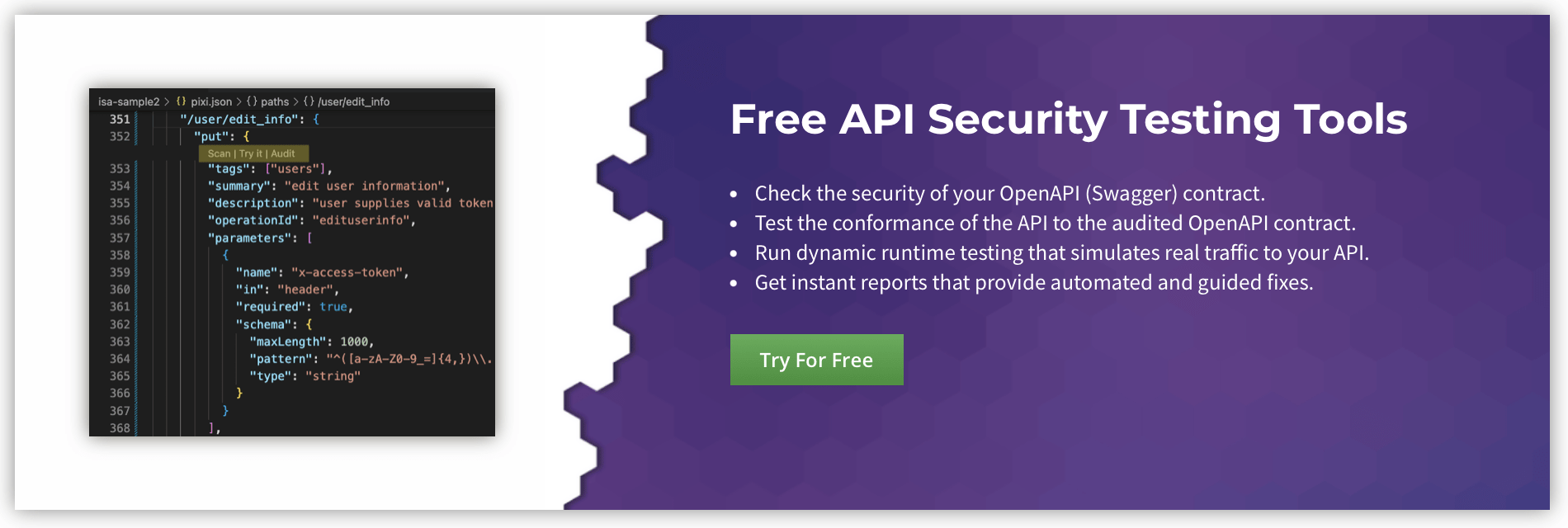
The fastest route to identifying the faults usually lies by consulting with the development team that built the API in order to analyze the associated OpenAPI Specification (OAS) or Swagger file that defines how the API should operate. Leveraging the declarative nature of the OAS file in combination with 42Crunch’s API-specific testing tools (API Audit – static testing of the API and API Scan – dynamic testing of the API) you can quickly assess the Data Validation and Security Conformance of the vulnerable API.
Given that a standard WAF still isn’t optimized to protect APIs, 42Crunch developed API Protect, a purpose-built API micro-firewall that enforces in real-time the API security policy to protect your APIs. API Protect complements the testing tools from 42Crunch and can be used as part of the testing process to prove that changes implemented at design and development time will be effective prior to deployment.
Once you have shored up the API by attaining a sufficiently high “security score” in the testing process, it is vital to ensure that the runtime implementation of your application retains that protection. API Protect is deployed from within the CI/CD pipeline and will automatically reconfigure every time updates are made to your spec. This gives peace of mind to security teams knowing that as the API specifications and security policies evolve over time, the underlying APIs and web applications will remain protected.
It is important to appreciate that an immediate plan of action must be implemented to ensure business continuity and that in parallel, a longer-term strategy should be adopted to prevent a recurrence of the damage and to protect the company’s overall API estate. 42Crunch has many demonstrable cases of intervening to generate immediate results but also is trusted by enterprises to implement a long-term API Security strategy.
Point the 42Crunch MCP scan at any MCP server and receive a scored report against the OWASP MCP Top 10 and your regulatory frameworks in under 60 seconds. No agent, no deployment, no commitment required.