
San Francisco, CA – February 11 2026 – 42Crunch, the API Security platform company, today announced the release of The State of API Security 2026 report, a data-driven analysis of the most common and consequential API vulnerabilities observed in production systems worldwide. Based on the review of API vulnerabilities and exploits reported globally between 2024 and 2025 as curated in the firm’s apisecurity.io community newsletter, this detailed study reveals how persistent implementation mistakes continue to expose sensitive data and critical business operations. The findings demonstrate that API security failures are consistent across industries, regardless of organization sizes and reveal the looming threat underway as AI agents and AI-powered systems become first-class API consumers.
Key Findings from the State of API Security 2026
-
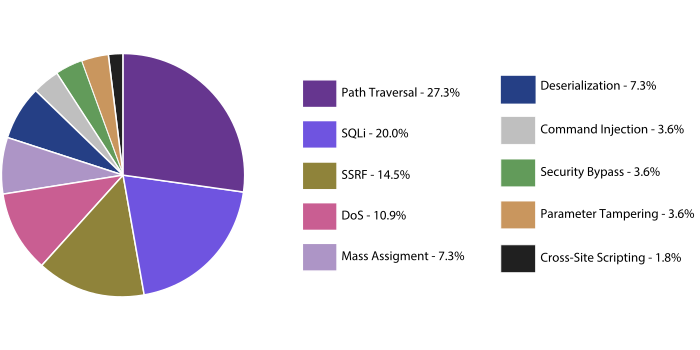
Broken Input Validation dominates API risk (28%)
The single largest category of vulnerabilities, including injection attacks, mass assignment, and path traversal, highlighting APIs as a primary conduit for malicious input into backend systems. -
Authorization failures remain a leading cause of breaches
Broken Object Level Authorization (BOLA) and Broken Function Level Authorization (BFLA) continue to expose sensitive resources and privileged operations, confirming authorization as one of the most difficult API security challenges to implement correctly. -
Missing Authentication accounts for 17% of reported vulnerabilities
The most frequently reported single vulnerability in 2025, driven by APIs that fail to enforce authentication server-side and instead rely on frontend or client-side controls. -
Strong alignment with OWASP Top API Risks
Four of the most prevalent real-world vulnerabilities directly map to four of the top five OWASP API Security Risks, validating the relevance of OWASP guidance against production data. -
The “trusted client” assumption is still widespread
Nearly 20% of analyzed cases showed APIs relying on client applications to enforce security, leaving APIs exposed when accessed directly by attackers. -
Few confirmed exploits of shadow or undocumented APIs
Despite heavy industry focus on API discovery, the report found little evidence that unmanaged or undocumented APIs are a primary driver of real-world breaches compared to weaknesses in known, documented APIs.
Commenting on the publication of the report, Hugh Carroll, CMO with 42Crunch, said “This study sheds light on how everyday API implementation mistakes can turn into real-world security incidents. The research reviewed over 200 vulnerabilities and offers valuable guidance on how security and development teams can prevent these problems occurring in the first place. Furthermore, it highlights how in an increasingly AI-driven world, predictability should become a security control designed in from the beginning, and APIs must be governed by deterministic guardrails, otherwise, agentic AI systems will find and operationalize weaknesses faster than organizations can respond.”
APIs, AI, and a Changing Risk Model
The report also highlights the critical shift in API risk as AI agents and LLM-powered systems become first-class API consumers. Unlike traditional applications, AI agents adapt their behavior based on API responses, probe boundaries, and infer undocumented capabilities. This dramatically increases the likelihood that long-standing, latent API vulnerabilities—often present in production for months or years—will be discovered and exploited automatically.
The State of API Security 2026 report delivers a data-driven analysis of over 200 real-world API vulnerabilities, showing how common mistakes in implementation translate into security risks in production. Readers gain actionable insights into the scenarios most likely to expose sensitive data, enabling them to prioritize defenses and governance across their API landscape. Download report now.
About 42Crunch
42Crunch is a leader in API security, helping enterprises reduce API-driven cyber risk across the fastest-growing attack surface in digital business. The 42Crunch API Security Platform combines continuous security testing with runtime protection to prevent vulnerabilities before APIs reach production and blocks malicious attacks in real time, including AI-driven probing, schema abuse and unauthorized data access. By embedding automated security and governance across the API lifecycle, 42Crunch enables organizations to build predictable, but well-defined APIs, without slowing development teams down. The 42Crunch API Security Platform is used by Fortune 500 enterprises and more than 2 million developers worldwide.
About APIsecurity.io
APISecurity.io is a community website for all things related to API security. Our daily news and biweekly API Security newsletter cover the latest breaches, vulnerabilities, standards, best practices, regulations, and technology. Sign up to the industry’s #1 online API Security community newsletter powered by 42Crunch.
Media Enquiries:
press@42crunch.com