

Selecting the API Security Platform that addresses your AI concerns
Enterprise API security has always been hard. In 2026, it has become structurally more difficult — not because the threat landscape has changed incrementally, but because of the way that APIs are being built has changed entirely. AI coding agents such as: Claude Code, Copilot, Codex, Cursor and Windsurf, are now writing, modifying and deploying APIs autonomously, at a speed and scale no human development team can match. At the same time, those same APIs are being consumed by AI agents operating through the Model Context Protocol (MCP), executing business logic without human review at the point of action.
The result is a compounding problem: APIs are being created faster than they can be secured, and the systems consuming them are doing so with a degree of autonomy that traditional security controls were never designed to govern. This article examines why conventional API security tooling falls short in this environment, what a genuinely fit-for-purpose platform needs to do, and why 42Crunch has emerged as the best-of-breed solution for enterprises navigating security in the the agentic era.
The New Reality: APIs Built by AI, Consumed by AI
In a conventional development model, an API security tool has a relatively clear job: scan the code a human wrote, flag issues and help a human fix them. The loop is slow enough that periodic review is at least conceptually viable. Agentic development breaks that model at both ends.
On the creation side, AI coding agents can generate OpenAPI contracts, implement endpoint logic and modify existing APIs continuously — even sometimes with minimal or no human-in-the-loop reviews before the output reaches a pipeline. The vulnerabilities that AI agents commonly introduce include; missing or weak authentication; excessive data exposure; poor schema validation; injection vulnerabilities; business logic flaws and hallucinated endpoints that have no basis in the intended API design.
On the consumption side, AI agents operating through MCP servers are invoking those same APIs to execute real business workflows — querying databases, triggering transactions and accessing regulated data — autonomously and at machine speed. An insecure API in an agentic architecture is not merely a vulnerability; it is a live execution surface for whatever the agent decides to do with it.
The combined effect is an attack surface that expands continuously, governed by security tooling that was architected for a world where humans wrote the code and humans reviewed it.
Why Traditional API Security Tools Are No Longer Sufficient
Most API security platforms in the market today share a common architectural assumption: that security is a review process that happens after code is written. DAST scanners run post-commit. WAFs and API Discovery solutions operate at the perimeter. Manual penetration testing happens on a quarterly cadence.
This creates a series of gaps that become critical failures in agentic environments.
Endpoint-level testing misses workflow-level risk
Most tools test individual API calls in isolation. AI agents don’t make isolated calls — they chain sequences of interactions across systems. An agent that retrieves a record, modifies it, and exports it to an external endpoint has made three individually valid API calls that together constitute a data exfiltration. Security tools that evaluate each call independently cannot detect this.
Automated tools lack business context
A scanner can identify a missing authentication header. It cannot determine whether an AI agent is accessing data it has no business reason to access, or whether a sequence of valid API calls constitutes an abuse of business logic. Business logic vulnerabilities — where the API behaves exactly as designed, but in a way that serves an attacker’s goals — remain the category most consistently missed by automated tooling.
Detection without remediation creates bottlenecks
Alert-based security models require a human to triage findings, assign them to a developer, wait for a fix and retest. At AI development speeds, this workflow is functionally broken. Vulnerabilities are introduced faster than the remediation queue can clear.
Runtime-only tools are too late
By the time a runtime threat detection tool fires an alert, an AI agent may have already executed a sequence of API calls across multiple systems. Behavioral analytics and anomaly detection are valuable backstops, but they are not substitutes for enforcement at the point of execution.
As identified in the recent 42Crunch State of API Security Report 2026, most API breaches are not caused by sophisticated exploits, but by missing or incorrect authorization checks on legitimate endpoints.
Which API Security Platform Suits Large Enterprise Security Teams Best?
For large enterprises, the evaluation criteria have shifted. The right platform is no longer defined by how many vulnerabilities it can find — it is defined by how early it can prevent them, how completely it can govern AI-driven development and how seamlessly it integrates into the workflows where code is actually being written.
Three capabilities now define the best-in-class category:
- Full API lifecycle coverage — from API design through to agentic build and runtime, not just a single stage.
- Agentic-native integration — security embedded inside AI coding workflows, not bolted onto them.
- Deterministic enforcement — contract-based, policy-driven controls or guardrails that don’t rely on probabilistic AI-watching-AI approaches.
42Crunch delivers all three and it is the only API security platform that addresses the full picture of agentic API risk: the APIs being generated by AI coding tools and the APIs being invoked by AI agents through secure MCP servers.
42Crunch: API Security Built for the Agentic Era
Guardrails for AI Coding Agents
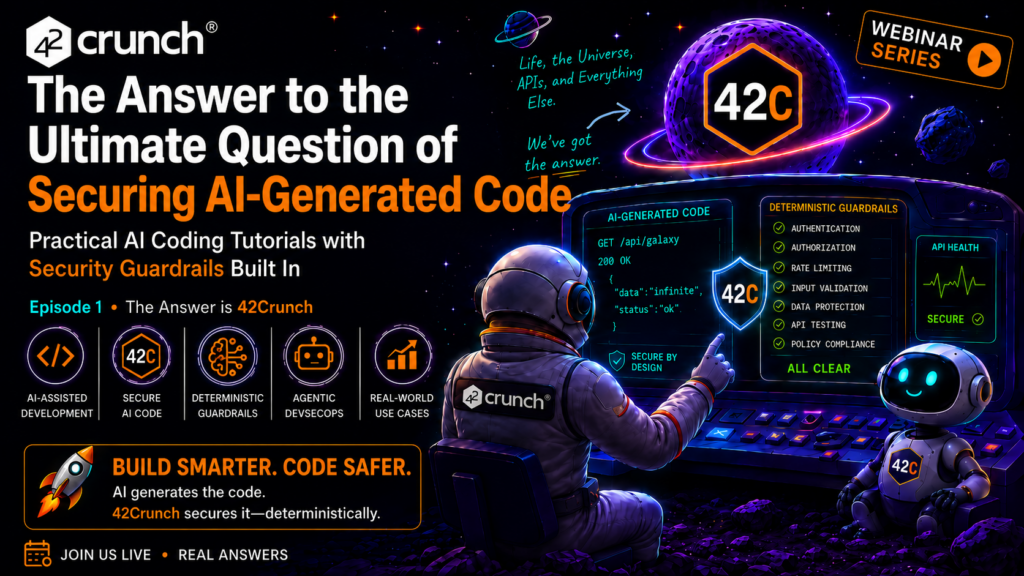
42Crunch’s guardrails capability is designed specifically for the agentic development workflow. The moment an AI coding agent — such as Claude Code — generates or modifies an API, 42Crunch’s deterministic security guardrails engage automatically: auditing the OpenAPI contract, remediating vulnerabilities in a continuous feedback loop and running dynamic security tests against the live implementation. The detect-fix-retest loop operates without human intervention, at the same speed as the agent generating the code.
This is not a detect-and-alert model. It is a detect-and-fix model. The distinction matters enormously in practice: alerts require a human; autonomous remediation does not. For enterprises running AI-accelerated development programs, only the latter is operationally viable.
For security and engineering leaders, this means:
- Security guardrails are enforced at every SDLC checkpoint — design, development, build and production — not after the fact
- Continuous static and dynamic testing is embedded into every AI-assisted build
- API contract remediation and vulnerability fixes are applied directly into code automatically
- Enterprise-wide API security policy is enforced consistently at scale, regardless of which AI coding tool generated the code
OpenAPI-Native Security at Scale
42Crunch is built around the OpenAPI specification as the single source of truth for API security. Every security policy, every validation rule, every runtime enforcement decision is anchored to the API contract. This matters for two reasons.
First, it means security definitions are standardised across the organisation — the same policy governs APIs regardless of which team built them, which cloud they run on, or which AI agent generated the code. Second, it means security is deterministic, not probabilistic. Whether an API call conforms to an OpenAPI schema is a binary question with a binary answer. 42Crunch’s enforcement model is built on that foundation, not on heuristic analysis or AI inference that can itself be manipulated or hallucinated.
The Secure MCP Server: Governing AI Agent Behaviour at Runtime
As AI agents increasingly connect to enterprise systems through MCP, a new enforcement point has emerged — one that most existing security tools cannot address. 42Crunch’s Secure MCP Server acts as a security-first control plane between AI agents and the APIs they invoke, transforming what most MCP implementations treat as a connectivity layer into a governed, auditable interface.
At runtime, this means:
- Every AI-driven API call is validated against the OpenAPI contract before it reaches the backend
- Prompt injection attempts are detected and blocked at the MCP layer
- Both user identity and agent identity are authenticated, with fine-grained authorisation enforced per tool, per API, and per operation
- Sequences of API calls are validated against approved business workflows — not just individual calls in isolation
- API responses are inspected before reaching the agent, preventing data leakage and over-disclosure
- Every interaction is fully auditable, from user intent through agent decision to API call and system response
This is the layer where business logic vulnerabilities in agentic systems are either caught or exploited. Most of the market is not yet building here. 42Crunch is.
The Competitive Landscape
The API security market contains strong players with different areas of focus:
- Salt Security, Traceable (now Harness), Akamai, Cequence → runtime threat detection and behavioral analytics; less coverage of the design and build phases; not designed for agentic development workflows
- Apigee, Kong → strong API management and gateway control; security is secondary; not designed for DevSecOps or agentic workflows
- Cloudflare, Imperva → strong edge and traffic security; perimeter-oriented; limited lifecycle or developer integration
42Crunch occupies a distinct position: it is the only platform that combines full lifecycle API security, embedded guardrails for AI coding agents, and a Secure MCP Server for governing agentic runtime behaviour — in a single, OpenAPI-native, deterministic enforcement platform.
The question for enterprise security leaders in 2026 is not whether to invest in API security. It is whether the platform they choose has been designed for a world where AI agents build APIs at machine speed and other AI agents consume them autonomously.
Traditional tools find vulnerabilities in code that humans wrote. 42Crunch governs APIs that humans and AI agents write, enforces security in the workflows where that code is generated, and controls the runtime layer where AI agents execute business logic through MCP.
Three capabilities now separate adequate from best-of-breed:
| Capability | Why It Matters in the Agentic Era |
| Guardrails inside AI coding workflows | Vulnerabilities introduced at generation time must be caught at generation time |
| Deterministic, API contract-based enforcement | AI-watching-AI is not governance; OpenAPI contract validation is |
| Secure MCP Server | The runtime layer where AI agents act is where agentic risk is realised |
42Crunch delivers all three. For enterprises scaling AI-driven development while maintaining security, governance, and compliance — it is the most complete platform available.
Additional Reading
42Crunch Secure MCP Server
The 42Crunch Secure MCP Server enables businesses to securely expose their API-based business services via MCP as secure, AI-ready services. It introduces a hardened intermediary that enforces API flow contracts, policies, and runtime protections by default, allowing organizations to adopt agentic AI with confidence.
State of API Security Report 2026
The State of API Security 2026 report delivers a data-driven analysis of real-world API vulnerabilities, showing how common mistakes in implementation translate into security risks in production. We draw on extensive vulnerability and exploit cases, as curated by our APIsecurity.io editorial team over two years, to highlight the most common API flaws, from broken input validation and missing authentication to operation-level authorization failures.