

The State of API Security in 2026: Analysis of real-world API vulnerabilities
Our recently published State of API Security Report 2026﹡ delivers a data-driven analysis of real-world API vulnerabilities, showing how common mistakes in implementation translate into security risks in production. It paints a clear and, at times, uncomfortable picture: despite years of awareness, tooling, and guidance, the same core API security failures continue to show up in real-world exploits. APIs now sit at the center of enterprise risk. They power digital services, connect partners, and increasingly act as the integration layer for AI systems and autonomous agents. That makes API security not just a development concern, but a board-level issue. What’s changed is the scale, speed, and impact—especially as organizations move toward AI-driven systems that rely heavily on APIs.
The API Vulnerabilities Still Doing the Most Damage
Analysis of vulnerabilities reported across 2024–2025 shows that the top five OWASP categories account for the majority of observed issues, reinforcing that attackers are still succeeding with well-known techniques.
At the top of the list is Broken Object Level Authorization (BOLA), which represents the single largest category of reported API vulnerabilities. Closely following are Broken Authentication, Broken Object Property Level Authorization (BOPLA), and Broken Function Level Authorization (BFLA). Together, authorization-related flaws dominate the threat landscape.
BOLA alone accounts for nearly half of authorization-related findings, with BFLA contributing just over 40%, and authorization bypass techniques making up the remainder.
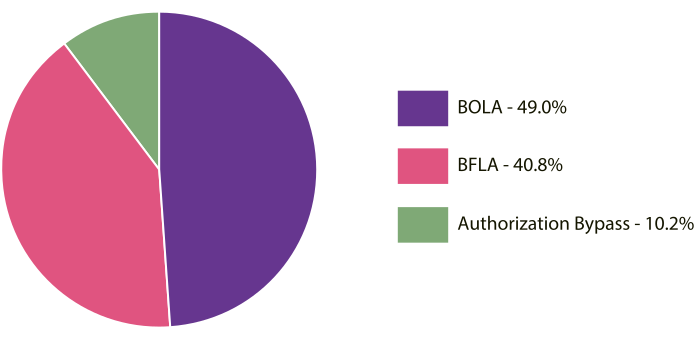
API Authorization vulnerabilities 2024-2025. Copyright © 42Crunch 2026.
The takeaway for security and engineering practitioners alike is pretty obvious: most API breaches are not caused by sophisticated exploits, but by missing or incorrect authorization checks on legitimate endpoints.
Why Authorization Keeps Failing at Scale
APIs are deceptively complex. Each endpoint can support multiple HTTP methods, each method can act on different resources, and each resource may require different permissions depending on context. As APIs evolve, that complexity compounds.
The report highlights that many BFLA cases stem from basic role-based access control errors, where functions intended only for privileged users are exposed to broader roles. In one cited real-world example, a sensitive password backup function was accessible to non-admin users via the API, despite being restricted in the UI.
For large enterprises, this points to a structural problem: security controls are often enforced inconsistently between UI, backend services, and APIs. Client-side controls give a false sense of security, while APIs—designed for reuse and integration—become the weakest link.
Authentication Still Isn’t Solved
Authentication failures remain another major contributor to API risk. The report documents recurring issues such as:
- Missing authentication on sensitive endpoints
- Weak authentication mechanisms (e.g., poorly validated JWTs)
- Authentication bypass through header or path manipulation
- Lack of rate limiting enabling brute-force attacks
What’s notable here is that these weaknesses often exist not because teams don’t know better, but because APIs are developed, deployed, and modified faster than security controls are reviewed. In large organizations with hundreds or thousands of APIs, gaps are inevitable without automation and governance.
Malicious Input and Misconfiguration Blindspots
Beyond Authentication and Authorization, the report also points to malicious input—including injection attacks and path traversal—as a persistent driver of API vulnerabilities. Some of these issues fall outside the current OWASP API Top 10 but still show up regularly in real-world findings .
Equally important are misconfigurations beyond the API code itself:
- Insecure API gateways
- Incorrect deployment settings
- Exposed debug or legacy endpoints
- Incomplete inventory coverage
For enterprise teams, this reinforces a key lesson: API security is not just a coding problem—it’s a lifecycle and operational problem.
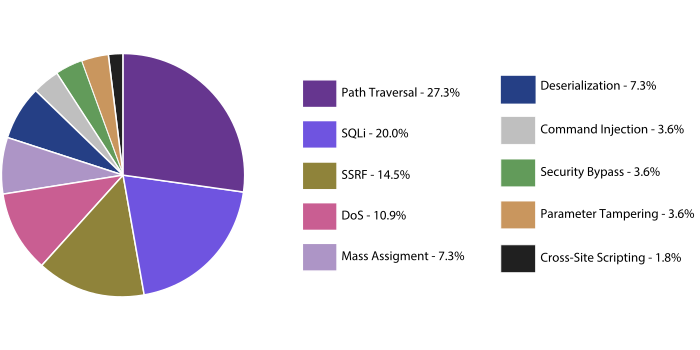
API Input Validation Flaws 2024-2025. Copyright © 42Crunch 2026.
AI Changes the API Risk Model—Fundamentally
The report makes it clear that AI will materially change the risk profile for APIs in 2026 and beyond.
AI systems—and especially agentic AI—consume APIs differently which can, indeed will, amplify inherent existing weaknesses:
- They make decisions autonomously
- They chain API calls across systems
- They operate at machine speed
- They may access APIs that were never designed for non-human actors
A broken authorization check that might have resulted in limited data exposure when exploited manually can now be abused repeatedly and systematically by an AI-driven process.
The implication for enterprises is critical: APIs are no longer just integration points—they are control surfaces for autonomous systems. AI adoption without mature API security multiplies risk faster than most organizations realize.
What This Means for Security and Engineering Teams
For large enterprises, the report’s findings point to several clear implications:
- Authorization must be treated as a first-class design concern, not an afterthought or UI-level control.
- Security-by-design matters more than reactive detection. Many of the vulnerabilities identified could have been prevented earlier in the lifecycle.
- Manual reviews do not scale to modern API ecosystems. Automation and policy enforcement are essential.
- APIs are now part of your AI attack surface, whether you intend them to be or not.
As if it needed to be said, but security and engineering teams need to work together more closely than ever—developers defining intent and functionality, security teams defining guardrails and enforcement.
The Bottom Line
The State of API Security Report 2026 doesn’t reveal a brand-new threat landscape—it confirms that the same fundamental API security issues continue to cause the most damage. What’s different now is the context: APIs sit at the center of digital transformation, cloud-native architectures, and AI-driven systems.
For large enterprises, the message is clear. Fixing API security basics is no longer an optional nice to have, doing so is a prerequisite for safely scaling AI. The organizations that succeed in 2026 will be those that treat APIs not just as interfaces, but as governed, enforceable security assets across the full lifecycle.
﹡State of API Security Report 2026
The State of API Security 2026 report delivers a data-driven analysis of real-world API vulnerabilities, showing how common mistakes in implementation translate into security risks in production. We draw on extensive vulnerability and exploit cases, as curated by our APIsecurity.io editorial team over two years, to highlight the most common API flaws, from broken input validation and missing authentication to operation-level authorization failures.