

GraphQL API Security
Audit, Test and Govern GraphQL APIs
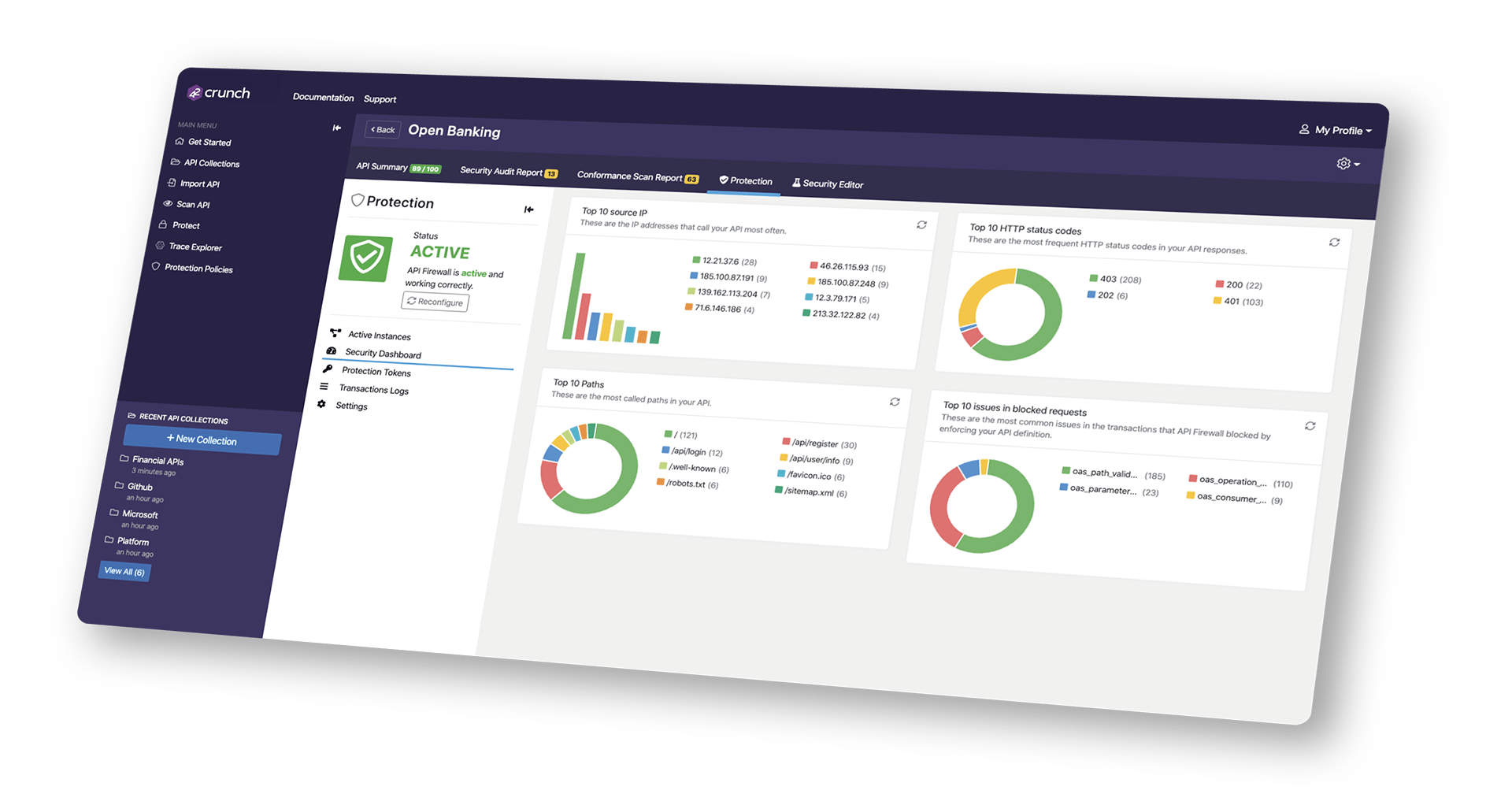
The 42Crunch API Security Platform enables companies to audit, test and govern GraphQL APIs with the same deterministic security controls used for REST APIs. GraphQL gives development teams a flexible way to access data, but it also creates a distinct security attack surface that conventional API and web security tools struggle to understand.
GraphQL APIs require dedicated security
GraphQL’s flexibility creates security risks that traditional REST-focused tools often miss. A single endpoint can expose an entire schema, support deeply nested queries, enable multiple operations per request and provide field-level access to sensitive data. Without GraphQL-aware controls, organisations face risks including schema exposure, resource-exhaustion attacks, unauthorised data access, unprotected mutations and security gaps across federated services.
Securing GraphQL APIs
42Crunch applies contract-first security to GraphQL APIs. It analyzes the GraphQL Schema Definition Language (SDL), tests running APIs against their contracts and enforces security standards through the automated 42Crunch Security Quality Gates (SQG). Development and security teams can identify and remediate GraphQL risks before release, maintain continuous governance through CI/CD and manage REST and GraphQL security from the 42Crunch API Security platform.
Audit the GraphQL SDL before deployment
42Crunch performs static security analysis directly against the GraphQL SDL. It identifies schema weaknesses before the API reaches production and gives developers a prioritised security score with actionable remediation guidance.
The GraphQL Audit evaluates:
- Introspection and data-exposure risks
- Missing authentication requirements on queries and mutations
- Unconstrained strings, custom scalars and input fields
- Missing length, pattern and numeric-range validation
- Query-cost and list-size control coverage
- Schema correctness and directive violations
- Security issues across Apollo Federation subgraphs
Scan in-production GraphQL APIs
42Crunch GraphQL Scan performs contract-aware dynamic testing against a live API in development, test or pre-production. Test cases are generated from the SDL, allowing the scanner to understand the API's operations, fields and expected behaviour.
Scan tests include:
- Authentication and authorization weaknesses
- Nested-operation and query-complexity abuse
- Mutation security failures
- Invalid and malicious field inputs
- Contract conformance
- Federation and subgraph security issues
Govern every GraphQL API release
42Crunch Security Quality Gates turn GraphQL security policy into an enforceable CI/CD control. Instead of simply reporting issues, the platform can fail a build or block a release when an API does not meet an organization's approved security threshold. This gives developers a clear pass-or-fail decision and security leaders evidence that policy is being applied before deployment.
Dedicated GraphQL quality gates allow security teams to:
- Define minimum security scores and acceptable risk thresholds
- Enforce consistent policies across development teams
- Identify the exact issues preventing an API from passing
- Apply approved customisation and exception rules
- Produce repeatable evidence of security checks
- Govern GraphQL and REST APIs through the same workflow
Strengthen runtime protection
The same contract validated during Audit and tested during Scan can support precise runtime enforcement. A well-defined schema with appropriate types, constraints, authentication requirements and cost controls creates a stronger security baseline for protecting the running API.
The result is a continuous security loop: Audit improves the contract, Scan verifies the implementation, Governance enforces release policy and runtime controls protect the approved API behaviour.
Frequently Asked Questions
Secure Your APIs Today
#1 API security platform