

MCP Security & Governance
Real-time compliance & security enforcement for the agentic enterprise
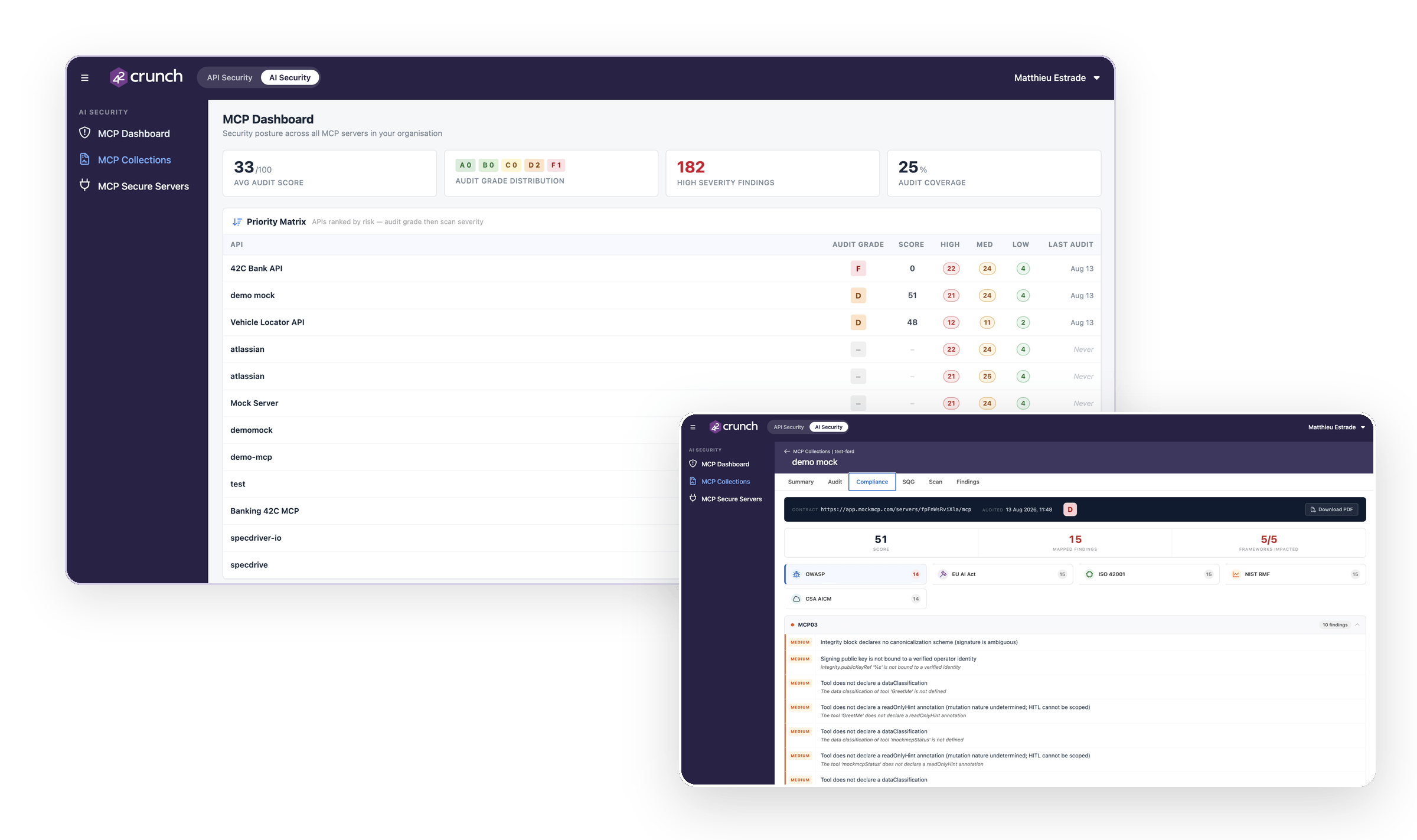
MCP is where AI compliance obligations are won or lost
MCP has become the de facto standard for AI agent-to-tool integration. AI agents now autonomously invoke tools, read resources and act on enterprise data through MCP servers, shifting integration from deterministic API calls to dynamic, agent-driven interactions. But MCP adoption is outpacing governance — Gartner reports that 40% of developers cite security, privacy or regulatory concerns with AI-powered applications.
Unmanaged MCP adoption creates shadow integration paths that bypass enterprise controls. A single mis-scoped tool, an unpinned instruction set or a logging gap produces untraceable agent actions and no evidence trail to prove to a regulator or auditor which controls were in place, or that they held. The NSA and OWASP both conclude that the protocol's security posture depends entirely on implementation discipline, not on protocol guarantees.
MCP Governance: from Discovery to Enforcement
42Crunch enables enterprises to govern the MCP servers they expose to agents, partners and customers. It goes beyond discovering servers and identifying risks: it evidences compliance against the frameworks you are accountable to, remediates vulnerabilities and blocks non-compliant servers — ensuring only secure, approved MCP services reach production.
Capabilities include:
01
MCP Discovery
Auto-discover, register and inventory MCP servers. Generate an MCP Contract for every server.
02
MCP Audit
Score data, security and protocol against the 42Crunch Knowledge Base — a deterministic baseline.
03
MCP Scan
Drift and policy-conformance scanning. Identity, runtime and behavioral tests.
04
Runtime Governance
Enforce Security Quality Gates in CI/CD. Block non-compliant servers, close the feedback loop
Real-time compliance reporting against regulatory frameworks.
42Crunch continuously evaluates every MCP server against the regulatory and industry frameworks your organization is accountable to, and maps each individual finding to the specific control it breaches. Compliance posture is computed by the control itself on every audit and every scan — not assembled from documents at audit time.
| Framework | What 42Crunch evidences | Reporting |
|---|---|---|
| NIST AI RMF | Govern, Map, Measure and Manage functions evidenced for every agent-accessible tool surface. | Per-finding control mapping |
| OWASP MCP Top 10 | Deterministic coverage of all ten MCP vulnerability classes, scored per server. | Scored 0–100 / A–F |
| EU AI Act | Technical documentation, logging, human oversight and risk-management obligations for high-risk AI systems. | Versioned audit record |
| ISO/IEC 42001 | AI management-system controls operationalized as machine-checkable requirements. | Continuous conformity |
| CSA AICM | AI Controls Matrix domains — including CCC and GRC control families — mapped to concrete findings. | Per-domain findings |
Built for audit evidence, not simple dashboards.
The 42Crunch MCPG Security and Governance solution porivdes GRC and Security teams with comprehensive , versioned, reproducible, exportable records that hold up when someone external asks "prove this control was in place and that it worked."
Deterministic MCP security enforcement at scale
42Crunch generates an MCP Contract for each server: a machine-readable, declarative specification of how that server must operate — its authentication requirements, authorization policies, operational limits, what each tool is permitted to do, and which security controls must be enforced. Every contract is written against a common enterprise policy schema, so coverage is consistent across the entire estate while remaining specific to each server. This contract is the single source of truth across discovery, audit, scanning and compliance reporting — every server is evaluated against explicit, approved requirements rather than subjective assessment.
MCP server vulnerability prevention
By validating tool definitions, inputs, credentials, permissions, isolation and delegated identity against the approved MCP Contract, 42Crunch blocks unsafe MCP servers before connection and detects drift or malicious changes after deployment. The matrix below represents the principal ways an MCP server can be manipulated, over-privileged or used to expose enterprise systems and data.
| MCP Vulnerability | Description |
|---|---|
| Tool Poisoning | Malicious instructions embedded in tool descriptions that hijack LLM behavior. |
| Rug Pulls | Dynamic replacement of a trusted tool definition with a malicious one at runtime. |
| Code & Command Injection | Model-provided inputs passed directly to shell, SQL, or system APIs without validation. |
| Credential Leakage | API keys and OAuth tokens improperly stored, logged, or cached. |
| Excessive Permissions | Over-privileged tools violating least-privilege — one breach compromises everything. |
| Insufficient Isolation | Cross-tenant data leakage, shared service accounts, unsandboxed execution. |
| Confused Deputy | Token passthrough allows an MCP server to be tricked into misusing user privileges. |
Source: OWASP, A Practical Guide for Secure MCP Server Development.
What the agentic enterprise gets
Frequently Asked Questions
Determine your MCP server compliance
baseline in 60 seconds.
Point the 42Crunch MCP scan at any MCP server and receive a scored report against
the OWASP MCP Top 10 and your regulatory frameworks in under 60 seconds.
No agent, no deployment, no commitment required.