

The numbers surrounding AI coding agents are no longer theoretical. A recent article from The Next Web investigating the Lovable breach suggests that between 40 and 62% of AI-generated code contains security vulnerabilities — and is being generated at 2.74 times the rate of human-written code. In Q1 2026, 91.5% of vibe-coded applications contained at least one vulnerability traceable to an AI hallucination. CVEs from AI-generated code rose from six in January to 35 in March, and researchers estimate the real figure is five to ten times higher. Meanwhile, the well worth a read Stackoverflow annual developer survey reveals that 84% of developers are using AI coding tools, and Gartner forecasts that 60% of all new code will be AI-generated by year end.
These numbers and indeed the AI coding tools are extraordinary, but the security practices and debt built around them are not.
The structural failure hiding in plain sight
The Lovable incident of April 2026 is instructive — not because it was unusual, but because it wasn’t. A broken object-level authorization (BOLA) vulnerability left thousands of projects exposed for 48 days after a researcher reported it. Anyone with a free account could access another user’s source code, database credentials, and personal data in a few API calls. The vulnerability classes — broken access controls, hardcoded secrets, disabled row-level security — appear consistently across every major vibe coding platform. They are not edge cases. They are defaults.
The Fortune magazine report on AI coding tool exploits confirms the pattern from a different angle. The breach of Amazon’s Q assistant, critical vulnerabilities in Cursor, GitHub Copilot, and Gemini CLI, and the “Agent Commander” prompt injection attack all point to the same conclusion: the attack surface is not the model — it is the ecosystem the agent operates in. The developer is currently the last line of defence. As CrowdStrike’s Adam Meyers observed: “It spits out hundreds of lines of code in minutes. Do they do a security assessment, or do they just say YOLO and deploy it?” Based on the breach data, YOLO wins far too often.
Why reactive security fails at AI velocity
The traditional model — build first, test later and fix whatever a penetration test flags — was already under strain. AI has broken it entirely. You cannot manually inspect every API endpoint, every schema, every authentication flow in a system generating thousands of lines per minute. By the time a vulnerability surfaces in production, the 48-day clock is already running.
Security by design: the only model that scales
The answer to an AI-speed code generation problem is security embedded in the AI’s workflow — enforced at the point of generation, not discovered after the fact.
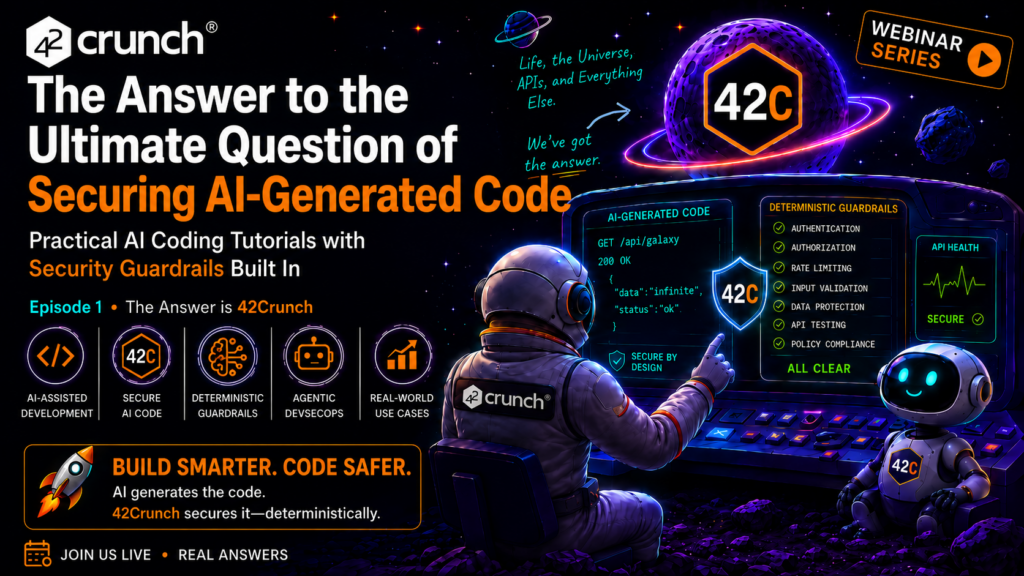
This is the principle behind 42Crunch’s API Security testing plugins for Claude, Codex and GitHub Copilot. Rather than adding security as a downstream gate, the plugins bring API security conformance directly into the IDE or the agent workflow, before the code reaches review, staging, or production.
Three reasons this matters specifically for AI-generated code:
AI agents have no security instincts
They are optimized to produce functional code. A plugin that enforces security conformance as part of generation changes what the AI coding agent produces, not just what gets reviewed afterward.
The attack surface is systematic, not random
The same vulnerability classes appear across every tool and platform. Because these patterns are consistent and machine-detectable, automated enforcement against an OpenAPI specification catches them comprehensively — something manual review at AI-code velocity cannot.
The developer is already in the IDE
Security feedback at the point of generation is fundamentally more effective than feedback at deployment — the code is still malleable, the context is immediate, and the fix is trivial rather than architectural.
What this looks like across the full lifecycle
The 42Crunch positive security model defines what valid API behavior looks like in the OpenAPI contract and enforces it at every stage:
- During generation — the 42Crunch plugin audits every API contract against the OWASP API Security Top 10, surfacing findings inline with severity ratings and remediation guidance.
- During CI/CD — API Scan performs dynamic conformance testing, catching gaps between the OpenAPI specification and the actual deployed implementation.
- At runtime — after deployment, the 42Crunch API Firewall enforces the contract on every live transaction, blocking non-conforming requests and validating outgoing responses to prevent data leakage.
The Lovable BOLA vulnerability is precisely the class of flaw contract-based enforcement catches.
The regulatory case for acting now
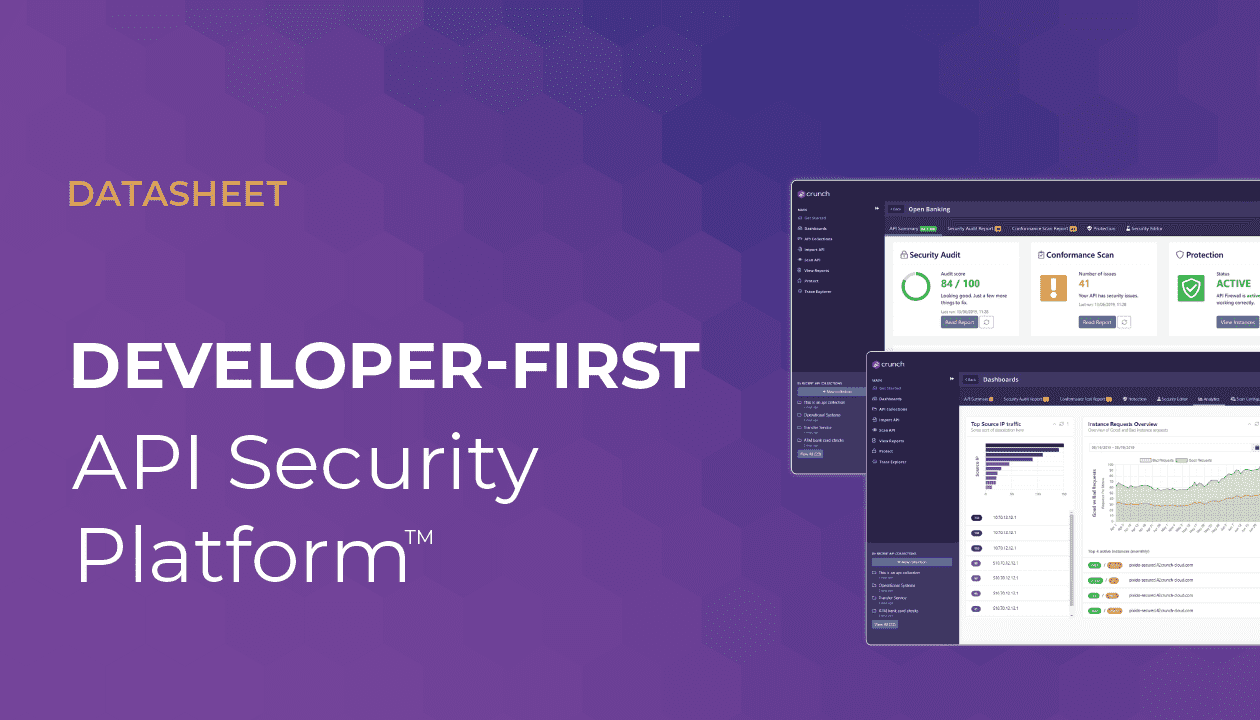
The EU AI Act’s high-risk obligations are live. Financial services and healthcare — the most regulated sectors — show the lowest vibe coding adoption rates (34% and 28% respectively), which suggests the market, thankfully, already recognizes the compliance gap even if regulation has not yet caught up. For organizations beginning to adopt AI coding agents, the requirement is not just responsible use. It is auditable proof that the APIs those agents produce meet a defined security standard. 42Crunch’s API Audit produces a machine-readable security score for every OpenAPI contract — an auditable artefact that security teams and compliance officers, can act on.
The only answer that matches AI velocity
The pattern across the past year of vibe coding incidents is consistent and leading to inherited security debt: AI generates code at speed, security review happens too late, systematic and machine-detectable vulnerabilities reach production and discovery oftentimes unfortunately comes from an independent researcher or a press article. This is not about stopping AI coding. It is about making AI coding enterprise-ready. The tools for a different outcome already exist. Embedding API security testing into the AI coding agent workflow is not a complex architectural change, it’s a straightforward plugin. The difference it makes is the difference between a finding caught in the development stages versus 48 days of exposure in production.
Additional Information
Join millions of developers securing APIs in their AI coding agents and IDEs today
- Automatically generate OpenAPI contracts
- Audit OpenAPI contracts for quality, conformance and security
- Dynamically scan APIs for security vulnerabilities
- Automatically apply code fixes directly in your API
- Enough tokens to see the product in action
- Upgrade options for individual and teams are available